Translation to be reviewed. This page is a translation of the French original, which remains the reference. Read the French version
Timeline
From 1927 to the 2027 centenary, the key dates in the life of Claude Martin, as far as the site’s documents allow them to be established.
Each date refers to its source ([A], [B], [C] or, for 2017, the press articles [D] and [E], at the bottom of the page). A dotted point marks a date still to be confirmed or on which the sources differ. An undated work, the list of emigrants [L], is presented after the timeline.
-
8 May
His parents, Roger Pierre Martin, a shopkeeper in Clairac, born in 1899, and Isabelle Odette Blanche de Robert, born in Bordeaux, marry in Bordeaux on 8 May 1922, according to the marriage record kept by the family.
-
1 March
Claude Martin is born on 1 March 1927 (date provided by the family). On his father’s side, he comes from a family settled in Clairac for generations (Martin, Clouzié, Jatz, Noguès); on his mother’s side, from gentlemen glassmakers of the Ariège (Robert, Grenier, Verbizier).
[A] Date provided by the family (civil record to be obtained); place to be specified
-
Adolescence 1940s — to be specified
As a teenager, he copied notarial deeds in attics; people entrusted him with “old papers”. The exhibition panel gives no date: “1940s” is deduced from his year of birth.
[A] 1940s — to be specified
-
Around 1945 At eighteen
At eighteen, he sets off by bicycle to the Ariège in search of the history and the cousins of his mother’s family, descended from the glassmaking gentlemen, as his niece Florence Lung recalled in a text published by the association La Réveillée in 2018.
Year deduced from his age His origins
-
1960s
From the 1960s onwards, the descendants of the emigrant families Saffin, Dutilh, Darné and Cobet came to meet him, from Vienna, London, Frankfurt, Mauritius, Rotterdam or Philadelphia. He received them in his houses at La Pause, then at Cambes, and kept up a regular correspondence with them. In the 1960s and 1970s, he published in the Revue de l’Agenais, the Revue historique de Bordeaux and the Bulletin de la Société d’histoire du protestantisme français.
-
“In 1966, establishment of the Musée historique du Clairacais”, in the Maison de Japhet, according to the exhibition panel. The Société des amis de Clairac, for its part, writes that the house was “taken over in the 1970s by Claude Martin, who created a fascinating museum of the Reformation in Clairac there”.
[A] [B] 1966 according to the exhibition panel; 1970s according to the Société des amis de Clairac — to be verified The Clairac museum
-
Some 400 descendants of the glassmaking families Robert, Grenier and Verbizier gather at Le Mas-d’Azil, before founding the association La Réveillée. Claude Martin, descended from these families through his mother, speaks there about the region’s former glassworks; he will sit on the association’s board as historian of the glassmaking families.
-
He organises in Clairac a gathering of several dozen descendants of emigrants. A Sud Ouest cutting kept by the family describes the meeting: participants from Mauritius, Belgium, West Germany, the United States, Canada, Algeria and Martinique, the family trees of the Boué, Denis, Caubet and Duvigneau families, a lecture by the archivist Lucile Bourrachot (see the record).
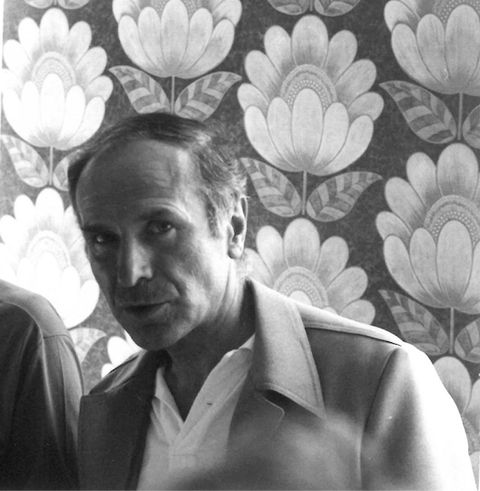
In 1978, at the gathering of descendants of Clairac emigrants. Société des amis de Clairac. -
July
Gathering of the Dutilh descendants in Clairac: 70 members of the family, from Holland, England, Switzerland, Spain and Turkey, according to the Société des amis de Clairac, which does not specify Claude Martin’s role. [B] A few days before the gathering, Sud Ouest presents him, aged 90, as the man who, with Clair Morizet, traced the family’s history at its request; the two of them, helped by the mayor, are accompanying the visit of some sixty descendants. [D] Two days later, the same newspaper attributes the initiative and the research to Chris Dutilh, helped by “two local historians, Claude Martin and Clair Morizet”. [E] None of these sources credits him with organising the gathering. On Saturday 22 July, a commemorative plaque is placed in rue Gambetta; the programme in the reunion booklet provides for it to be unveiled by the mayor and by Claude Martin.
Numbers: 70 [B], some sixty [D] or 66 [E] depending on the source The Dutilh reunion of 2017
-
7 February
Claude Martin dies on 7 February 2018 (date provided by the family): “who died last February”, writes the Société des amis de Clairac in its newsletter of May 2018. After a service at the Protestant church in Clairac, he is buried on the family property of Cambes, near his mother, according to La Réveillée’s tribute.
-
12 November
The Huguenot Library (University College London) acknowledged receipt of a copy of his unpublished work, French Protestants (Huguenots) in Clairac, 1600s-1700s: Lists of refugees from Clairac and the surrounding Lot-et-Garonne area of France, donated by his niece Florence Lung, through Glenys Bolland.
-
1 March — centenary
Claude Martin would have turned 100 on 1 March 2027. A commemoration is being prepared in Clairac. The story continues.

The list of emigrants from Clairac
Claude Martin compiled a typewritten list of the “Emigrés de CLAIRAC en Agenois Province de Guyenne”: each person’s surname, first name and destination, and a summary that announces 261 people. [L]
The date on which he compiled this list is not known: it therefore does not appear in the timeline.
To place his life in the history of Clairac, from the Reformation to the Refuge: the Clairac timeline.
Complete the timeline
Do you know a date, a place or a document that clarifies these milestones — his birth, his early work, the creation of the museum? Contributions are reviewed before any publication.
Send a document Read about his life
Sources
- [A] Exhibition panel “Claude Martin” (PDF, original document in French)
- [B] Société des amis de Clairac, Newsletter no. 1, May 2018 (PDF, original document in French)
- [C] Letter from the Huguenot Library (UCL, London), 12 November 2019 (PDF, original document in English)
- [D] Catherine Darbord and Jean Escodo, “Une passionnante histoire de famille” (A fascinating family story), Sud Ouest (sudouest.fr, Tonneins section), 20 July 2017 — online article (article not reproduced on this site) — record in the archives
- [E] Jérôme Souffrice, “Les Dutilh de retour aux sources” (The Dutilhs back to their roots), Sud Ouest (print edition, Lot-et-Garonne page), 22 July 2017 — no known online version (article not reproduced on this site) — record in the archives
- [L] Claude Martin, “Emigrés de CLAIRAC en Agenois Province de Guyenne”, typed list, 3 pages, date unknown — facsimile and transcription